

Running a small business in Monmouth County, New Jersey, has never been more rewarding — or more legally complex. From the restaurant strips of Asbury Park to the tech corridors of Holmdel and the retail hubs of Red Bank, local entrepreneurs are navigating a business environment that is shifting faster than most people realize.
In 2026, that shift has brought a new wave of legal exposure. Regulations have tightened. Employment laws have evolved. Contract disputes are on the rise. And many small business owners are still operating with the same handshake agreements and boilerplate templates they started with years ago.
The result? Legal problems that were entirely preventable — and in many cases, incredibly expensive.
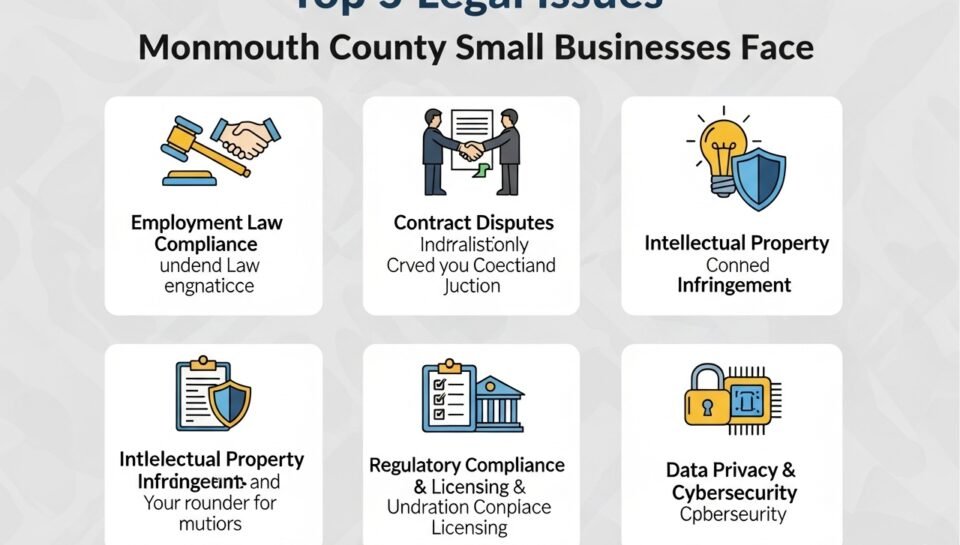
This guide breaks down the top five legal issues Monmouth County small businesses are facing right now, what is causing them, and what steps you can take to protect yourself before a manageable problem becomes a crisis.
1. Contract Disputes and Poorly Drafted Agreements
If there is one legal issue that touches nearly every small business in Monmouth County, it is this one. Contract disputes — between business owners and vendors, clients, contractors, or partners — are consistently the most common reason small businesses end up in litigation.
And the root cause is almost always the same: the contract was too vague, too generic, or written without the specific needs of the business in mind.
In 2026, this problem has grown more acute. Supply chain pressures have forced many businesses into fast agreements with new vendors they do not know well. Service-based businesses are dealing with scope creep and payment disputes at higher rates than ever. And commercial landlords and tenants across Monmouth County are frequently at odds over lease terms, CAM charges, and renewal options — often because the original lease was never negotiated properly.
A solid contract does more than put words on paper. It defines expectations, limits liability, establishes dispute resolution procedures, and gives you legal standing when something goes wrong. An online template simply cannot do that for your specific situation.
The solution starts before any deal is signed. Having a business attorney review, draft, or negotiate your agreements is not a luxury — it is basic risk management. Whether you are signing a vendor agreement, a client services contract, a commercial lease, or a non-disclosure agreement, every document your business commits to should be reviewed by someone who knows New Jersey contract law.
The Law Offices of Paul H. Appel offers comprehensive contract drafting, review, and negotiation services in New Jersey for Monmouth County businesses of all sizes. From NDAs and employment agreements to commercial leases and service contracts, every document is tailored to protect your specific interests — not just to check a box.
2. Business Structure Problems and Personal Liability Exposure
One of the most critical decisions any business owner makes is how to structure their business. Yet in Monmouth County, a surprising number of small businesses are still operating with outdated structures, improperly maintained LLCs, or no formal entity at all — leaving owners personally exposed to every business liability.
In 2026, this issue has taken on new urgency for several reasons. New Jersey has increased enforcement activity around business compliance. Lenders and investors are scrutinizing corporate governance more carefully than they used to. And courts have become less forgiving of business owners who have “pierced the corporate veil” through sloppy record-keeping, co-mingled funds, or unsigned operating agreements.
Here is the reality: an LLC or corporation only protects your personal assets if it is set up correctly and maintained properly. That means having a current operating agreement, holding proper meetings (even if informal), keeping business and personal finances separate, and filing all required state documents on time.
For many businesses, the right structure also changes over time. A sole proprietor who was fine as a freelancer may now need an LLC. A two-person LLC that has grown to 15 employees may benefit from an S-Corp election for tax purposes. A family business getting ready to bring in outside investment may need to think about a C-Corp structure.
These are not decisions to make based on a quick Google search. The implications for taxes, liability, succession, and fundraising can be enormous — and getting it wrong early creates problems that compound over time.
If you are unsure whether your current business structure is still the right fit, or if you have never had your operating agreement reviewed by an attorney, now is the time. The Law Offices of Paul H. Appel provides business entity formation services in New Jersey to help Monmouth County businesses choose the right structure, maintain it properly, and build a foundation that actually protects them.
3. Employee Misclassification and New Jersey Labor Law Compliance
New Jersey has some of the most employee-protective labor laws in the country — and in 2026, enforcement has only gotten more aggressive. For small businesses in Monmouth County, the single most dangerous compliance trap is worker misclassification: treating employees as independent contractors when the law says otherwise.
New Jersey’s ABC Test is notoriously strict. To classify a worker as an independent contractor, a business must prove all three of the following: (A) the worker is free from control and direction of the business; (B) the work performed is outside the usual course of the business’s activities; and (C) the worker is customarily engaged in an independently established trade or business. Failing even one of these criteria means the worker should have been classified as an employee — with all the payroll taxes, benefits, and protections that come with it.
The consequences of getting this wrong are severe. The New Jersey Department of Labor can assess back wages, unpaid payroll taxes, penalties, and interest. In egregious cases, business owners can face personal liability. And class action lawsuits from misclassified workers have become increasingly common across the state.
Beyond misclassification, 2026 has brought a slate of other compliance pressure points for Monmouth County employers. These include updated requirements around pay transparency, expanded leave protections, and stricter rules around non-compete agreements. New Jersey courts have been steadily narrowing what counts as an enforceable non-compete, and businesses relying on outdated agreements may find they have far less protection than they think.
Employment law compliance is not a one-and-done task — it requires regular review as laws evolve. For businesses that need ongoing support without the cost of in-house counsel, working with a virtual general counsel in New Jersey can be a highly effective solution. You get access to experienced legal advice on employment questions, contract reviews, and compliance matters as they arise — at a predictable monthly cost that fits a small business budget.
4. Partnership and Shareholder Disputes
Businesses built on trust between partners or co-owners are some of the most rewarding to run — and some of the most legally vulnerable when that trust breaks down. In 2026, partnership and shareholder disputes remain one of the most destructive legal issues facing Monmouth County small businesses.
The pattern is familiar. Two or three people start a business together with great energy and aligned goals. Over time, priorities diverge. One partner wants to grow aggressively; another wants to reduce risk. One owner feels they are doing more work than the others. A family health issue changes someone’s availability. A difference of opinion over a major business decision becomes a standoff.
Without a detailed, attorney-drafted operating agreement or shareholder agreement that addresses these situations in advance, a deadlock can freeze business operations, damage client relationships, and lead to expensive litigation. In the worst cases, courts get to decide how to unwind the business — often at significant cost to everyone involved.
The most common mistake business owners make is assuming a dispute will never happen to them. The second most common mistake is waiting until a dispute has already started to get legal help.
Proactive legal planning — including clear agreements on decision-making authority, profit distribution, buyout rights, and dissolution procedures — is far less expensive and disruptive than litigation after the fact. And when disputes do arise, skilled representation in mediation, arbitration, or court can make the difference between a business that survives and one that does not.
The Law Offices of Paul H. Appel handles all aspects of business litigation and dispute resolution in New Jersey, with a particular focus on reaching practical business solutions rather than running up legal fees in protracted court battles. If you are in a partnership and do not have a current, attorney-drafted agreement in place, that is the first thing to fix.
5. Failure to Conduct Regular Legal Risk Reviews
The fifth legal issue on this list is less about any single dispute and more about a fundamental gap in how most small businesses approach their legal health: they do not think about it until something goes wrong.
In 2026, the pace of regulatory change, combined with the complexity of running a business in New Jersey, makes a reactive approach genuinely dangerous. Employment laws change. Contract requirements evolve. Data privacy regulations are expanding. Local zoning and permitting rules shift. What was compliant two years ago may not be compliant today.
Small businesses that operate for years without any formal legal review often discover — at the worst possible moment — that their employment policies expose them to discrimination claims, their independent contractor agreements will not survive an audit, their commercial lease contains provisions they never understood, or their corporate records are so incomplete that a prospective buyer or lender walks away from a deal.
A regular legal risk review — done proactively, not reactively — is one of the highest-return investments a small business can make. It identifies vulnerabilities before they become liabilities, ensures ongoing compliance, and gives business owners the confidence to make major decisions without second-guessing the legal foundation underneath them.
This is exactly the value that Monmouth County NJ business law services from an experienced local attorney can provide. The Law Offices of Paul H. Appel works with businesses throughout Monmouth County — from Freehold and Red Bank to Asbury Park, Holmdel, Marlboro, and beyond — to conduct comprehensive business legal risk analyses, update outdated documents, and build a proactive legal strategy tailored to each client’s industry and growth stage.
You do not need a full-time in-house attorney to have this kind of ongoing legal support. What you need is the right relationship with the right business lawyer.
The Bottom Line: Legal Problems Do Not Announce Themselves
One of the most dangerous things about these five issues is that they tend to be invisible until they are not. A contract dispute starts the day the contract is signed — not the day the other party stops paying. An employment liability begins the moment a worker is misclassified — not the day the Department of Labor comes knocking. A partnership dispute starts the day two co-owners first disagree on strategy — not the day they stop speaking.
Monmouth County small businesses that take their legal foundation seriously — that work with an experienced business attorney before problems arise, not after — are consistently better positioned to survive setbacks, attract investors, retain employees, and grow.
If any of the five issues in this guide sound familiar, the best time to act was a year ago. The second-best time is today.
The Law Offices of Paul H. Appel is located at 11 Crestwood Drive in Freehold, NJ, and serves small businesses throughout Monmouth County and the surrounding region. With over 50 years of New Jersey business law experience, Paul H. Appel provides the kind of direct, experienced, senior-level counsel that most small business owners have never had access to — until now.
📞 Call 917-748-6124 or email paul@paulappellaw.com to schedule a consultation.