

Going public is one of the most significant milestones a private company can reach — but the traditional IPO route is not the only path. Reverse mergers have become an increasingly attractive strategy for private companies looking to access public markets quickly, without the lengthy regulatory timelines and overhead that a conventional IPO typically demands. For New Jersey business owners and entrepreneurs exploring this option, understanding the legal landscape of reverse mergers is not just helpful — it is essential.
At The Law Offices of Paul H. Appel, we provide experienced legal guidance to business owners navigating the complexity of reverse merger transactions in New Jersey. With decades of practice in corporate and commercial law, we help clients structure, negotiate, and complete these transactions with the legal precision they require.
What Is a Reverse Merger?
A reverse merger — sometimes called a reverse takeover or RTO — occurs when a private company acquires a controlling interest in a publicly traded shell company. The result is that the private company effectively “goes public” without going through a traditional initial public offering. The shell company, which already trades on a stock exchange but typically has no active business operations, becomes the surviving legal entity. The private company’s shareholders receive shares in the public shell, transforming the private company into a publicly traded business.
This structure has grown in popularity for several reasons. It allows companies to bypass some of the most time-consuming aspects of a traditional IPO — including lengthy SEC review periods, road shows, and investment bank underwriting requirements. For small to mid-sized businesses with strong fundamentals but limited access to institutional capital, a reverse merger can open doors that would otherwise remain closed.
That said, reverse mergers are not simple transactions. They involve intricate legal, regulatory, and structural considerations that require experienced legal counsel from start to finish.
Why New Jersey Businesses Are Pursuing Reverse Mergers
New Jersey’s business environment is uniquely suited to the kinds of growth-oriented transactions that reverse mergers enable. The state is home to a dense concentration of small and mid-sized enterprises across industries like technology, healthcare, manufacturing, logistics, and professional services. Many of these companies reach a stage of growth where they need access to public capital but do not yet qualify — or cannot wait — for a traditional IPO.
A reverse merger offers them a strategic shortcut. Rather than spending 12 to 24 months navigating the conventional IPO process, a reverse merger can often be completed in a fraction of that time. For NJ entrepreneurs who have built strong businesses and are ready to scale, this matters enormously.
However, New Jersey-based transactions must also comply with both federal securities laws and state-level corporate governance requirements. This dual layer of compliance is one of the key reasons why working with a qualified M&A attorney in New Jersey is not optional — it is critical.
The Key Legal Steps in a Reverse Merger Transaction
Completing a reverse merger involves a structured series of legal steps. Skipping or mishandling any one of them can create serious liabilities for both the private and public company involved. Here is a breakdown of the core legal components:
1. Identifying and Vetting the Shell Company
Not all shell companies are created equal. Some carry hidden liabilities, unresolved litigation, outstanding tax obligations, or regulatory violations. A thorough legal review of the target shell company is the first and most important step. This includes reviewing the shell company’s SEC filings, financial statements, outstanding debt, corporate records, and any pending or prior legal actions.
As part of comprehensive business transaction services in New Jersey, our firm conducts deep-dive evaluations of shell company targets to ensure clients are not inheriting problems alongside the public listing.
2. Structuring the Transaction
How the reverse merger is structured has major implications for taxes, control, and future financing. The transaction may be structured as a stock exchange, asset acquisition, or a statutory merger under applicable state law. Each structure carries different legal consequences for existing shareholders, management control, and ongoing SEC reporting requirements.
The structure of the deal must also account for how shares will be allocated between the shell company’s existing shareholders and the private company’s shareholders. This requires careful negotiation and precise legal drafting. Our attorneys regularly advise clients on business entity restructuring in connection with acquisitions to ensure the transaction aligns with both immediate goals and long-term corporate strategy.
3. Drafting the Merger Agreement
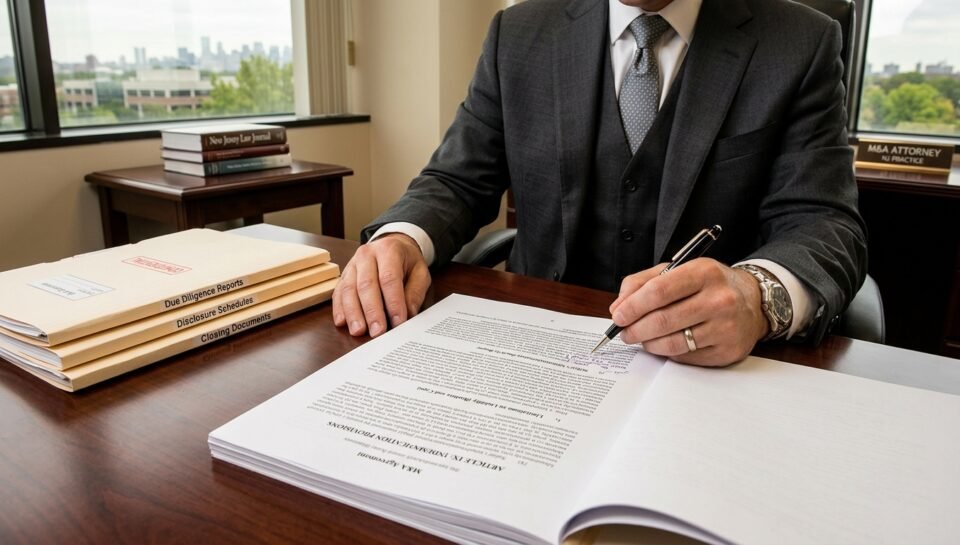
The merger agreement is the foundational legal document for any reverse merger. It governs the terms of the transaction, including representations and warranties from both parties, conditions to closing, indemnification provisions, termination rights, and post-closing obligations. This document must be drafted with exceptional care, as it will govern the rights and responsibilities of all parties going forward.
Working with an attorney experienced in merger agreement drafting in New Jersey is essential at this stage. Ambiguous language, missing provisions, or improperly drafted warranties can expose both parties to significant legal risk after the deal closes.
4. Shareholder Approvals and Corporate Governance
Most reverse mergers require approval from the shareholders of both the shell company and the private company. This process is governed by both the relevant state’s corporate statutes and the company’s own governing documents — articles of incorporation, bylaws, and any existing shareholder agreements.
Failing to properly secure shareholder approval for a merger can invalidate the transaction entirely or create grounds for shareholder litigation after the fact. Our firm ensures that all required approvals are obtained in strict compliance with applicable legal requirements, and that voting procedures, notice requirements, and disclosure obligations are all properly handled.
5. SEC Compliance and Disclosure Requirements
Because a reverse merger results in a private company becoming publicly traded, the surviving entity takes on all the ongoing disclosure and reporting obligations of a public company. This includes filing a Form 8-K with the SEC to report the transaction, updating the shell company’s registration statements, and ensuring that the combined company’s financial statements are prepared in accordance with applicable SEC standards.
Additionally, the SEC has increased its scrutiny of reverse merger transactions in recent years, particularly those involving shell companies with questionable histories. Legal counsel plays a critical role in preparing accurate and complete SEC disclosures to avoid enforcement actions or trading suspensions.
Common Legal Pitfalls in Reverse Mergers
Even sophisticated business owners can find themselves in difficult legal situations if a reverse merger is not properly managed. Some of the most common pitfalls include:
Hidden Liabilities in the Shell Company. Many shell companies carry undisclosed or inadequately disclosed liabilities. Without thorough due diligence, the acquiring private company can find itself responsible for debts, lawsuits, or regulatory violations it knew nothing about at closing.
Improper Capitalization Structure. Getting the post-merger capitalization table wrong can dilute existing shareholders more than anticipated, create governance problems, or trigger regulatory issues. Precise legal and financial modeling is required before any shares change hands.
Failure to Comply with Blue Sky Laws. In addition to federal securities laws, New Jersey and other states have their own “blue sky” securities laws that regulate the offer and sale of securities. A reverse merger that complies with federal law may still run afoul of state-level requirements without proper legal guidance.
Inadequate Representations and Warranties. If the representations and warranties in the merger agreement are too narrow or imprecise, parties may find they have no legal recourse when problems surface post-closing. Strong, well-drafted reps and warranties — and robust indemnification provisions — are non-negotiable.
Post-Closing Integration Issues. Legal issues do not end at closing. Integrating two companies’ operations, employment relationships, contracts, and regulatory obligations requires ongoing legal attention. Without a plan in place, post-closing integration can quickly become a source of disputes and liability.
The Importance of Working With an Experienced New Jersey M&A Attorney
Reverse mergers sit at the intersection of corporate law, securities law, tax law, and contract law. They require an attorney who can navigate all of these disciplines simultaneously and who understands the specific legal environment of New Jersey. Generic legal advice is not sufficient for a transaction of this complexity.
Paul H. Appel, Esq. brings more than 58 years of corporate and commercial law experience to every transaction he handles. A graduate of Columbia Law School, he has advised New Jersey businesses through some of the most intricate M&A and corporate restructuring transactions imaginable. His approach is proactive — identifying legal issues before they become problems, rather than responding to crises after the fact.
Whether you are a private company exploring a reverse merger as a path to public markets, or a stakeholder in a shell company evaluating an incoming merger proposal, The Law Offices of Paul H. Appel provides the sophisticated legal counsel your transaction demands.
Who Should Consider a Reverse Merger in New Jersey?
Reverse mergers are not the right fit for every business. They tend to make the most sense for companies that:
- Have a proven business model and revenue history, but lack the scale or visibility for a traditional IPO
- Need access to public capital markets relatively quickly
- Have management teams willing to take on the ongoing compliance obligations of a public company
- Are in industries where public status provides a competitive advantage — such as technology, biotech, or manufacturing
If your company fits this profile and you are based in New Jersey — whether in Monmouth County, Middlesex County, Ocean County, or anywhere else in the state — our firm is equipped to guide you through the full lifecycle of a reverse merger transaction.
Start With a Consultation
A reverse merger is one of the most consequential decisions a business owner can make. The legal complexity is real, the regulatory scrutiny is increasing, and the margin for error is narrow. The right legal partner can mean the difference between a transaction that propels your business forward and one that creates years of legal exposure.
The Law Offices of Paul H. Appel serves businesses throughout New Jersey and the greater New York metropolitan area. We offer personalized, experienced legal counsel on reverse mergers and all related M&A and corporate transactions.