

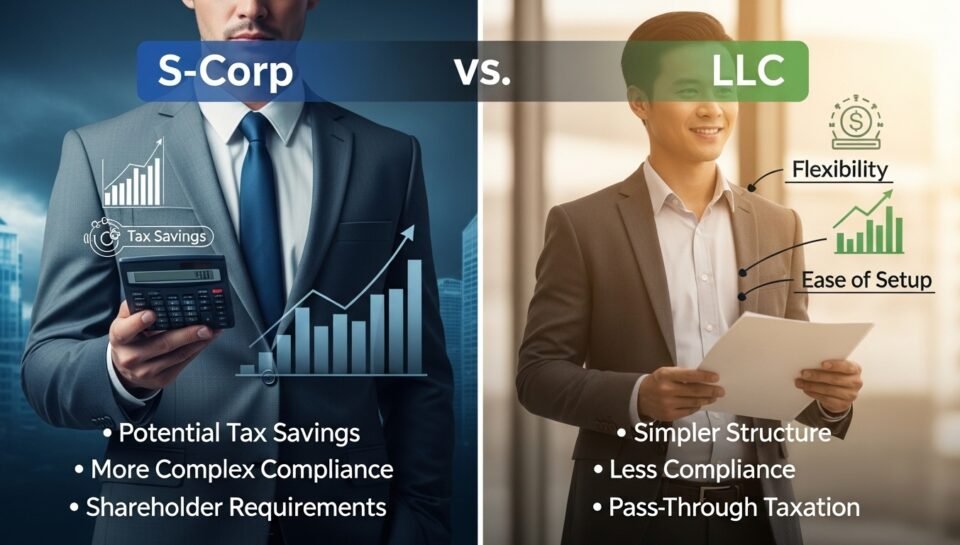
Starting a business in New Jersey is an exciting milestone — but one of the most critical decisions you’ll face early on is choosing the right legal structure. Two of the most popular options for New Jersey entrepreneurs are the Limited Liability Company (LLC) and the S-Corporation (S-Corp). Both offer meaningful liability protection and favorable tax treatment, but they differ significantly in how they operate, what they cost, and who they’re best suited for.
The wrong choice can result in unnecessary taxes, compliance headaches, or even personal liability down the road. The right choice, made with proper legal guidance, can save you thousands of dollars and protect your personal assets for years to come.
This guide breaks down everything New Jersey business owners need to know about LLCs versus S-Corps — covering taxes, structure, costs, legal requirements, and which entity makes sense depending on your specific situation.
What Is an LLC in New Jersey?
A Limited Liability Company (LLC) is a flexible business entity that separates your personal assets from your business liabilities. If your business is sued or goes into debt, your personal savings, home, and car are generally protected. At the same time, an LLC avoids the double taxation associated with traditional corporations.
In New Jersey, forming an LLC requires filing a Certificate of Formation with the New Jersey Division of Revenue and Enterprise Services, drafting an Operating Agreement, and paying applicable state fees. The Operating Agreement — while not legally required by New Jersey — is a critical document that outlines ownership percentages, management responsibilities, and profit distribution.
LLCs in New Jersey are taxed as pass-through entities by default. This means profits and losses pass directly to the members’ personal tax returns, and the LLC itself pays no federal income tax. However, New Jersey does impose an annual LLC fee based on the number of members, ranging from $150 to $250 per year, in addition to any applicable income taxes.
If you’re launching a new business or a small professional services firm and want a straightforward, low-maintenance structure with strong liability protection, working with an experienced LLC formation attorney in NJ can ensure everything is done correctly from day one.
What Is an S-Corp in New Jersey?
An S-Corporation is not actually a separate entity type under state law — it’s a federal tax election made with the IRS. You first form a standard corporation (or sometimes an LLC) under New Jersey law, and then elect S-Corp tax status by filing IRS Form 2553.
Like an LLC, an S-Corp is also a pass-through entity for federal tax purposes. The corporation itself does not pay federal income tax. Instead, profits and losses are passed through to the shareholders’ personal returns.
The key distinction — and main benefit — of S-Corp status is the potential for self-employment tax savings. Under S-Corp rules, owner-employees must pay themselves a reasonable salary (which is subject to payroll taxes). However, any remaining profits distributed as dividends are not subject to self-employment tax (currently 15.3%). For business owners earning significant net profits, this split can result in substantial savings.
New Jersey recognizes S-Corp status for state tax purposes and generally follows the federal pass-through treatment. However, New Jersey imposes a minimum corporation tax on S-Corps, which starts at $500 per year and scales up with gross receipts. S-Corps in New Jersey are also subject to the New Jersey Corporation Business Tax on certain income allocable to the state.
Key Differences: LLC vs. S-Corp in New Jersey
1. Taxation and Self-Employment Tax
This is typically the deciding factor for most business owners.
With a single-member LLC, all net profits are treated as self-employment income and subject to the 15.3% self-employment tax (12.4% Social Security + 2.9% Medicare). So if your LLC earns $100,000 in profit, you owe self-employment taxes on the full amount.
With an S-Corp, you split income between salary and distributions. If you pay yourself a reasonable salary of $60,000 and take $40,000 as a distribution, you only pay payroll taxes on the $60,000 salary. That $40,000 distribution is not subject to self-employment tax — potentially saving you over $6,000 per year.
However, this advantage only kicks in when your net profit is consistently high enough — generally $50,000 or more per year in net income after expenses. Below that threshold, the added administrative costs of an S-Corp often outweigh the tax savings.
2. Formation and Ongoing Compliance
An LLC is simpler and cheaper to form. The New Jersey filing fee is relatively low, and ongoing compliance primarily involves filing an annual report and paying the LLC fee.
An S-Corp involves more formality. You must hold annual meetings, maintain minutes, adopt corporate bylaws, issue stock, and file additional tax forms (including IRS Form 1120-S). In New Jersey, corporations also have more rigorous registration and reporting requirements.
If compliance and administrative burden are concerns — especially for a solo entrepreneur or small team — an LLC is generally the more manageable structure. This is one reason why many NJ business owners start by exploring their options with a comprehensive business entity formation attorney before committing to a structure.
3. Ownership and Flexibility
LLCs are highly flexible. They can have unlimited members, including foreign nationals and other entities such as corporations or trusts. Profit-sharing can be customized in the Operating Agreement and does not have to follow ownership percentage.
S-Corps are more restrictive. They are limited to 100 shareholders, and all shareholders must be U.S. citizens or permanent residents. S-Corps can only issue one class of stock, and ownership stakes must align with profit and loss distributions.
If you plan to bring on investors, expand ownership internationally, or need flexible equity arrangements, an LLC is usually the better fit. S-Corps work well for closely held companies with a small group of domestic shareholders.
4. State-Level Taxes in New Jersey
New Jersey is one of the more tax-intensive states for businesses, and this affects both entities.
LLCs in New Jersey pay a flat annual fee (currently $150 for 1–2 members, up to $250 for 10+ members). Members report their share of income on their personal NJ-1040 returns and pay state income tax at their individual rate.
S-Corps pay New Jersey’s minimum corporation business tax (starting at $500) plus any applicable New Jersey CBT on income. They must also file Form CBT-100S annually. New Jersey does not allow the S-Corp federal election to automatically exempt all state-level corporate tax — meaning you still have some corporate-level obligations at the state level.
5. Credibility and Professional Image
In some industries, operating as a corporation can convey a higher level of professionalism and credibility to clients, vendors, and lenders. This is particularly true in industries like finance, consulting, and professional services.
That said, LLCs are widely recognized and respected, and many multi-million-dollar businesses in New Jersey operate as LLCs without any credibility concerns.
When Should You Choose an LLC?
An LLC is generally the better choice if you:
- Are just starting out and want a simple, low-cost structure
- Expect net profits below $50,000 per year in the near term
- Want flexibility in how profits are distributed among members
- Have or plan to have multiple owners with varying ownership stakes
- Want minimal administrative and compliance obligations
- Need to allow non-U.S. owners or other entities as members
For startups especially, the flexibility and simplicity of an LLC make it the go-to choice. Entrepreneurs launching a new venture in New Jersey will find that the startup legal support services available through experienced NJ attorneys can help them structure things properly from day one — without overpaying on taxes or compliance requirements they don’t need yet.
When Should You Choose an S-Corp?
An S-Corp election is typically the better choice if you:
- Are consistently earning $50,000 or more in net profit after expenses
- Are currently paying significant self-employment taxes as a sole proprietor or LLC member
- Are a solo or small-group professional (doctor, consultant, contractor, etc.) with stable income
- Want to establish a more formal governance structure for a closely held business
- Are comfortable with the added compliance requirements of a corporation
The self-employment tax savings are the primary driver for choosing S-Corp status. If your business is at the stage where those savings are meaningful, consulting with a NJ S-Corp setup lawyer will help you navigate the IRS election, payroll setup, and New Jersey corporate filings correctly.
Can You Convert an LLC to an S-Corp Later?
Yes — and this is actually a very common strategy for New Jersey business owners. Many entrepreneurs start as an LLC for simplicity, then elect S-Corp tax status once their income grows to a level where the savings become significant.
You can make the S-Corp election on an existing LLC without dissolving it and forming a new entity. However, the process involves careful tax planning, the right timing of your IRS election, and setting up payroll systems. An experienced New Jersey business attorney can walk you through the conversion at the right moment.
This is also why the LLC vs. S-Corp decision doesn’t have to feel permanent — what matters most is getting your initial structure right, with an eye toward future flexibility.
The Role of Contracts and Governance Documents
Whether you form an LLC or S-Corp, your foundational legal documents matter enormously. An LLC’s Operating Agreement governs how the business runs, how decisions are made, how profits are split, and what happens if an owner wants to exit. An S-Corp’s Bylaws and Shareholder Agreement serve similar purposes.
These documents are not mere formalities. Poorly drafted agreements are among the leading causes of costly business disputes. Getting professional help with contract drafting and business agreements in New Jersey ensures that your governance structure reflects the actual intentions of the owners and protects everyone involved.
New Jersey-Specific Considerations
New Jersey has its own unique tax landscape that can influence the LLC vs. S-Corp decision in ways that differ from other states. A few important points for NJ business owners:
New Jersey’s CBT: New Jersey imposes its Corporation Business Tax on S-Corps in certain situations, even though they enjoy pass-through status federally. The minimum tax is $500 per year but can increase based on gross receipts.
BAIT (Business Alternative Income Tax): New Jersey’s BAIT allows pass-through entities — including both LLCs and S-Corps — to pay state income tax at the entity level and take a corresponding federal deduction, potentially reducing the owners’ overall federal tax burden. This is a significant planning opportunity that was introduced to work around the federal $10,000 SALT deduction cap.
Local licensing and compliance: Depending on your municipality, there may be additional local licensing requirements and fees that apply to corporations but not LLCs (or vice versa). Understanding the full compliance picture in your specific county or city is important.
These nuances reinforce the value of working with a New Jersey business attorney who understands both the state and federal dimensions of entity planning — not just someone who files paperwork on your behalf.
LLC vs. S-Corp in NJ: A Quick Comparison
| Factor | LLC | S-Corp |
|---|---|---|
| Formation Complexity | Simple | More involved |
| Self-Employment Tax | Paid on all profits | Only on salary portion |
| Annual NJ Cost | $150–$250 fee | $500+ minimum tax |
| Ownership Restrictions | None | 100 shareholders max, U.S. only |
| Governance Requirements | Minimal | Annual meetings, minutes, bylaws |
| Best For | Startups, flexible ownership | Profitable small businesses |
| Profit Distribution Flexibility | High | Low (must follow stock ownership) |
Don’t Go It Alone — Get the Right Legal Guidance
The LLC vs. S-Corp decision is not one-size-fits-all. The right answer depends on your income level, industry, growth plans, number of owners, and personal financial situation. A structure that saves one business owner thousands in taxes could create unnecessary costs and headaches for another.
Before you file any paperwork or make any elections, speak with an experienced New Jersey business attorney who can assess your situation holistically — not just hand you a form to fill out.
The Law Offices of Paul H. Appel has been helping New Jersey entrepreneurs and business owners navigate entity formation, tax planning, and corporate compliance for decades. Whether you’re launching a brand-new venture, restructuring an existing business, or thinking about converting your LLC to an S-Corp, Paul H. Appel provides the personalized, practical legal guidance you need to get it right.
Ready to make the right choice for your business? Contact The Law Offices of Paul H. Appel today for a consultation.
Attorney review: Reviewed for legal accuracy by Paul H. Appel, Esq. This article provides general information and does not constitute legal advice.