

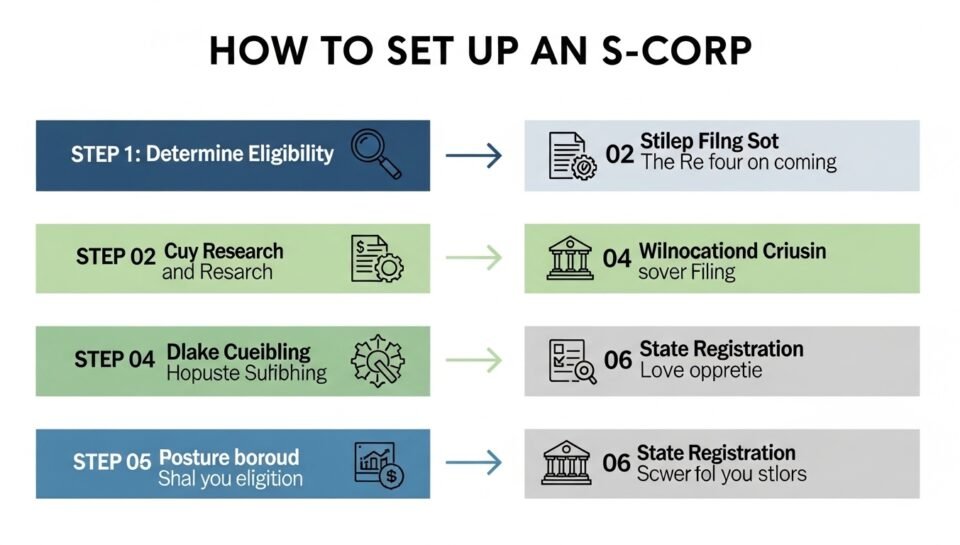
Starting a business in New Jersey is exciting — but choosing the right legal structure can feel overwhelming. Among the most tax-efficient and legally protective options available to small business owners is the S-Corporation, or S-Corp. Whether you are a solo entrepreneur, a professional services provider, or a growing company with a small team, understanding how to set up an S-Corp in New Jersey correctly from day one can save you thousands of dollars in taxes and protect your personal assets from business liabilities.
This guide breaks down every step of the S-Corp formation process in New Jersey, covering state-specific requirements, IRS filings, ongoing compliance obligations, and why having an experienced New Jersey business attorney in your corner makes the entire process smoother, faster, and far less risky.
What Is an S-Corp and Why Does It Matter in New Jersey?
An S-Corporation is not a separate type of business entity — it is a tax election. A corporation or, in some cases, an LLC elects to be taxed under Subchapter S of the Internal Revenue Code. This means the business itself does not pay federal income tax at the corporate level. Instead, profits and losses “pass through” to the individual shareholders, who report them on their personal tax returns.
For New Jersey business owners, this structure offers a powerful combination of benefits:
- Pass-through taxation that eliminates the double taxation problem common with C-Corporations
- Self-employment tax savings because shareholder-employees pay themselves a reasonable salary and take additional profits as distributions, which are not subject to self-employment taxes
- Personal liability protection that keeps your personal assets separate from business debts and lawsuits
- Professional credibility that comes with operating as a formal corporation
However, S-Corps come with strict eligibility rules and ongoing compliance requirements that make the formation process more involved than a simple LLC registration. Getting it right matters, and that is why working with a qualified S-Corp setup lawyer in New Jersey is one of the smartest investments you can make for your business.
Step 1: Determine If an S-Corp Is Right for Your Business
Before filing a single document, you need to confirm that your business qualifies for S-Corp status under IRS rules. The eligibility requirements are strict:
- The business must be a domestic corporation (incorporated in the U.S.)
- It can have no more than 100 shareholders
- All shareholders must be U.S. citizens or permanent residents
- There can only be one class of stock
- Certain types of businesses — such as financial institutions, insurance companies, and domestic international sales corporations — are ineligible
Beyond the IRS eligibility test, you should also evaluate whether an S-Corp is the right fit for your specific financial situation. If your business earns enough profit that self-employment tax savings would outweigh the additional administrative costs of running a corporation, an S-Corp election usually makes excellent financial sense. A good rule of thumb that many tax professionals use is that businesses with net profits of $40,000 or more per year can typically benefit from S-Corp taxation.
It is also worth comparing an S-Corp to an LLC at this stage. Both offer liability protection and pass-through taxation, but they differ significantly in management structure, paperwork requirements, and flexibility. If you are unsure which entity type fits your goals, consulting a New Jersey LLC formation attorney who can walk you through the pros and cons of each structure will help you make an informed decision.
Step 2: Choose and Reserve Your Business Name
Every corporation in New Jersey must have a unique name that is distinguishable from existing businesses registered with the state. Your chosen name must include a corporate designator such as “Inc.,” “Corp.,” “Incorporated,” or “Corporation.”
You can check name availability through the New Jersey Division of Revenue and Enterprise Services business name search tool. If you find an available name you want to protect before completing your formation documents, you can file a Name Reservation Application to hold it for up to 120 days.
A few things to keep in mind:
- Avoid names that could be confused with government agencies
- Check federal and state trademark databases to avoid potential infringement issues
- Consider whether the domain name is available if you plan to build a web presence under your business name
Step 3: Appoint a Registered Agent in New Jersey
New Jersey law requires every corporation to maintain a registered agent — an individual or business entity with a physical address in New Jersey that is authorized to receive official legal and government correspondence on behalf of the corporation.
Your registered agent must be available during normal business hours to receive service of process, tax notices, and other official documents. You can serve as your own registered agent if you have a physical New Jersey address (not a P.O. Box), or you can appoint an attorney, a trusted individual, or a professional registered agent service.
Many business owners choose to have their attorney serve as registered agent because it ensures that critical legal notices are handled promptly and professionally by someone who understands their legal implications.
Step 4: File a Certificate of Incorporation with New Jersey
This is the foundational document that officially creates your corporation under New Jersey law. You will file a Certificate of Incorporation with the New Jersey Division of Revenue and Enterprise Services, along with the required state filing fee.
Your Certificate of Incorporation must include:
- The corporation’s official name
- The purpose of the corporation (a general statement is typically acceptable)
- The name and address of your registered agent in New Jersey
- The number of authorized shares and their par value
- The names and addresses of the incorporators
Once the state processes and approves your filing, your corporation legally exists. Processing times vary, but expedited filing options are available for an additional fee if you need faster turnaround.
Step 5: Draft Corporate Bylaws
While New Jersey does not require you to file corporate bylaws with the state, they are a critical internal document that every properly formed corporation should have. Bylaws establish the rules for how your corporation will be governed, including:
- How and when shareholder and board meetings are conducted
- The roles and responsibilities of officers and directors
- How decisions are made and documented
- Procedures for issuing stock and transferring ownership
- How disputes among shareholders will be handled
Well-drafted bylaws protect you and your co-owners from future misunderstandings and legal disputes. They are also frequently required by banks when opening business accounts and by investors or lenders reviewing your company. This is one of the areas where having an experienced New Jersey business law attorney makes a measurable difference — generic template bylaws often fail to address the specific circumstances of your business.
Step 6: Hold an Organizational Meeting and Issue Stock
After filing your Certificate of Incorporation, you must hold an initial organizational meeting of the board of directors. During this meeting, you will:
- Formally adopt the corporate bylaws
- Elect officers (such as a President, Secretary, and Treasurer)
- Authorize the issuance of shares to initial shareholders
- Open a corporate bank account
- Adopt an accounting period and tax year
All decisions made at this meeting should be formally documented in written meeting minutes, which become part of your corporate records. Maintaining complete and accurate corporate records is not just good practice — it is essential to preserving your liability protection. Courts can “pierce the corporate veil” and hold shareholders personally liable for business debts if the corporation fails to maintain proper formalities.
Step 7: Obtain an EIN and Register for New Jersey Taxes
Before you can hire employees, open a business bank account, or file the S-Corp election with the IRS, you need an Employer Identification Number (EIN) from the IRS. You can apply for an EIN online through the IRS website at no cost, and most applicants receive their number immediately.
You will also need to register with the New Jersey Division of Revenue and Enterprise Services for state tax purposes. Depending on your business activities, this registration may cover:
- New Jersey Corporation Business Tax
- Sales and Use Tax (if you sell taxable goods or services)
- Employer Payroll Withholding (if you have employees)
New Jersey has its own unique tax landscape that requires attention. Unlike most states, New Jersey does not fully conform to the federal S-Corp election, which means your corporation may still owe New Jersey Corporation Business Tax even after making the S-Corp election with the IRS. Understanding these state-specific tax nuances is another area where professional legal and accounting guidance pays for itself many times over. Business owners across Monmouth County, for example, regularly turn to experienced counsel when structuring their entities — as the team at The Law Offices of Paul H. Appel serving Marlboro Township and surrounding areas can attest.
Step 8: File IRS Form 2553 — The S-Corp Election
This is the step that transforms your standard New Jersey corporation into an S-Corp for federal tax purposes. You must file IRS Form 2553 (Election by a Small Business Corporation) signed by all shareholders.
Timing is critical:
- To take effect for the current tax year, you must file Form 2553 no later than the 15th day of the third month of that tax year (typically March 15 for a calendar-year corporation)
- If you miss that deadline, the election will take effect for the following tax year
- For new corporations, the election can be filed at any time during the tax year of incorporation or by March 15 of the following year
Once the IRS approves your election, you will receive a confirmation letter. Keep this letter in your corporate records permanently — you may need to produce it for banks, investors, or tax authorities in the future.
Step 9: File New Jersey Form CBT-2553 for State S-Corp Treatment
New Jersey requires a separate state-level S-Corp election in addition to the federal IRS election. You must file New Jersey Form CBT-2553 with the New Jersey Division of Taxation to receive New Jersey S-Corp treatment.
This is a step that many business owners and even some general-practice attorneys overlook, resulting in unexpected state tax bills. The New Jersey S-Corp election must generally be filed on or before the first day of the tax year for which it is to take effect, although exceptions exist for newly formed corporations.
Making both the federal and state elections correctly, on time, is one of the most consequential parts of the S-Corp setup process. Mistakes here can cost you significantly in back taxes, penalties, and interest. Business owners in areas like Freehold Township who work with an experienced local business law firm — such as those who rely on business legal solutions in Freehold Township, NJ — avoid these costly errors because their attorney manages the entire filing timeline.
Step 10: Open a Dedicated Business Bank Account and Establish Payroll
Once your corporation is formed and your tax elections are in place, you need to establish a clear financial separation between your personal and business finances. This means:
- Opening a dedicated corporate checking account in the corporation’s name
- Using that account exclusively for business income and expenses
- Setting up a formal payroll system to pay yourself a reasonable salary as a shareholder-employee
The “reasonable salary” requirement is one of the most important and scrutinized aspects of S-Corp compliance. The IRS requires S-Corp owner-employees to pay themselves a salary that is reasonable for the services they perform. You cannot simply take all distributions and avoid payroll taxes entirely — doing so is a common audit trigger. Work with your accountant and attorney to determine a defensible salary figure based on your industry, role, and local market rates.
Ongoing Compliance Requirements for New Jersey S-Corps
Forming your S-Corp is just the beginning. Maintaining your corporate status and liability protection requires ongoing attention to several compliance obligations:
Annual Report: New Jersey requires corporations to file an Annual Report with the Division of Revenue and Enterprise Services each year, along with the applicable fee. Failure to file can result in your corporation being placed in “revoked” status.
Corporate Tax Filings: Even with the S-Corp election in place, New Jersey S-Corps must file the NJ-CBT return and may owe minimum state taxes. Federal S-Corp returns are filed on Form 1120-S.
Maintaining Corporate Formalities: This means holding annual meetings, keeping accurate minutes, documenting major decisions in writing, and maintaining your corporate records book.
Registered Agent Maintenance: Ensure your registered agent information with the state remains current and that someone is reliably available to accept legal notices.
Payroll Compliance: Process and report payroll taxes at both the federal and state levels on a consistent schedule.
Why Work With a New Jersey S-Corp Attorney?
Setting up an S-Corp in New Jersey involves more moving parts than most business owners anticipate. The combination of state-specific filings, dual tax elections, ongoing compliance requirements, and the high cost of errors makes this a process where professional legal guidance delivers real, measurable value.
An experienced S-Corp setup lawyer in New Jersey can:
- Confirm your eligibility and recommend the right structure for your specific situation
- Handle all state and federal filings accurately and on time
- Draft customized bylaws and shareholder agreements that protect your interests
- Advise on setting a defensible reasonable salary
- Keep your corporation in good standing with ongoing compliance support
- Represent you if issues arise with the IRS or the New Jersey Division of Taxation
At The Law Offices of Paul H. Appel, attorney Paul H. Appel brings over four decades of New Jersey business law experience to every client engagement. Whether you are forming your first business or restructuring an existing one, the firm provides practical, results-driven counsel that protects your interests and gives your business the legal foundation it needs to thrive.
Final Thoughts
Setting up an S-Corp in New Jersey is one of the most impactful legal decisions you can make for your business’s long-term financial health. The tax savings, liability protection, and professional structure an S-Corp provides are real and significant — but only if the formation is done correctly and maintained properly over time.
From choosing your business name to filing IRS Form 2553 and New Jersey Form CBT-2553, every step in the process has consequences that reach years into your company’s future. Taking shortcuts or relying on generic online filing services may save a few dollars today but can create expensive problems down the road.
If you are ready to set up an S-Corp in New Jersey — or if you want to evaluate whether an S-Corp is the right move for your existing business — reach out to The Law Offices of Paul H. Appel today for a consultation. With experienced legal guidance, your S-Corp will be structured correctly, compliant, and positioned to deliver every advantage it was designed to provide.
Attorney review: Reviewed for legal accuracy by Paul H. Appel, Esq. This article provides general information and does not constitute legal advice.