
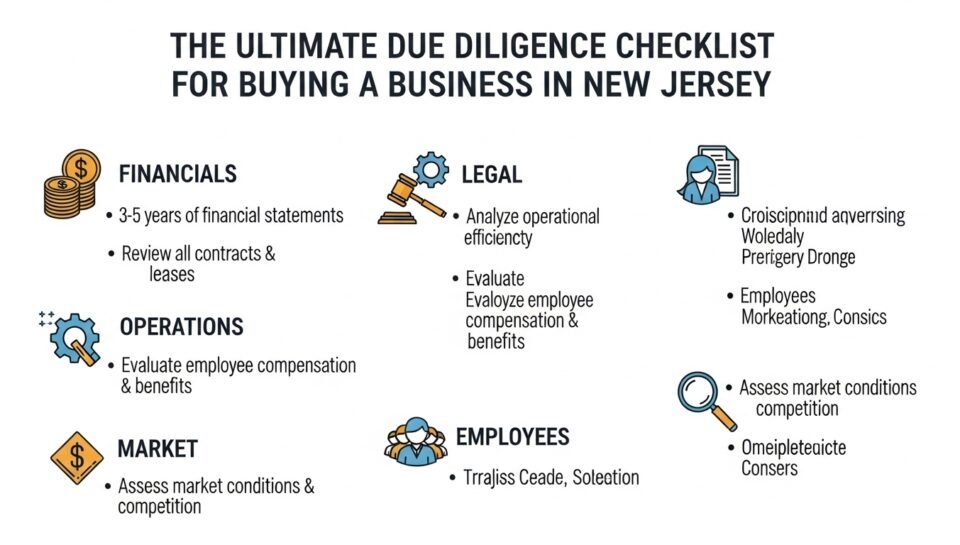
Buying a business is one of the biggest financial decisions you will ever make. Whether you are acquiring a restaurant in Red Bank, a medical practice in Toms River, or a retail operation in Monmouth County, the process involves far more than agreeing on a price and signing paperwork. Without a thorough due diligence process, you could inherit debts you never agreed to, lose a liquor license you assumed was transferable, or discover that the seller’s financials were misleading months after closing.
This guide walks you through a complete due diligence checklist specifically tailored to buying a business in New Jersey — including the state-specific legal requirements that every buyer must understand before they commit to a deal. Working with an experienced attorney who provides business transactions services in NJ is not optional at this stage — it is essential.
What Is Due Diligence and Why Does It Matter?
Due diligence is the formal process of investigating a business before you finalize a purchase. Think of it as the “audit” phase of a transaction: you are verifying that what the seller has represented is actually true and uncovering anything they may not have disclosed — whether intentionally or not.
In New Jersey, due diligence takes on added importance because of state-specific laws around bulk sales, tax liability transfers, liquor license compliance, and employment classification. Skipping or rushing this step is the single most common cause of post-acquisition disputes and buyer’s remorse.
Part 1: Financial Due Diligence
The first area to investigate is the financial health of the business. You need to verify income, expenses, debt obligations, and cash flow — not just accept the seller’s representations at face value.
What to review:
- Three to five years of profit and loss statements, balance sheets, and cash flow statements
- Federal and state tax returns for the past three to five years
- Accounts receivable and accounts payable aging reports
- All outstanding loans, lines of credit, or promissory notes
- Payroll records and employee compensation history
- Sales tax filings and remittance history with the New Jersey Division of Taxation
- Any outstanding judgments, liens, or tax assessments
Pay special attention to trends. Is revenue growing or declining? Are profit margins stable? Are there any unexplained spikes or drops in income? If the numbers do not align with the seller’s representations, that is a serious red flag requiring further investigation.
Part 2: Legal and Corporate Structure Review
Before you purchase any business, you need to fully understand its legal structure, ownership history, and any pending or past litigation.
What to review:
- Articles of incorporation or organization filed with the New Jersey Division of Revenue
- Operating agreements, shareholder agreements, or partnership agreements
- Minutes from board meetings or member meetings for the past three years
- Current ownership structure and any existing buy-sell agreements
- Any pending, threatened, or historical litigation or administrative proceedings
- Outstanding regulatory violations or consent orders
- Judgments, liens, or encumbrances on business assets
If the business is structured as an LLC or corporation, determine whether you are buying assets or ownership interests. This matters enormously for liability purposes. In an asset purchase, you can generally avoid inheriting the seller’s liabilities — but only if the transaction is properly structured. Our team handles buying and selling businesses and M&A in NJ, and we guide buyers through this critical structural decision every day.
Part 3: New Jersey Bulk Sale Notification Requirements
This is one of the most critical and frequently overlooked components of buying a business in New Jersey. Under the New Jersey Bulk Sale Law (N.J.S.A. 54:50-38), when a business is sold, the buyer is required to notify the New Jersey Division of Taxation at least ten business days before the closing date.
If you fail to comply with the bulk sale notification requirement, you — the buyer — can be held personally responsible for the seller’s unpaid New Jersey state taxes. This exposure can easily reach tens or hundreds of thousands of dollars and has nothing to do with any misrepresentation by the seller.
The steps involved include filing Form C-9600 with the state, receiving a clearance letter or escrow requirement from the Division of Taxation, and ensuring that any tax hold is resolved before or at closing. No experienced New Jersey buyer should proceed to closing without confirming that this process has been properly followed.
Part 4: Contract and Agreement Review
A business operates through a web of contracts — with customers, vendors, employees, landlords, and service providers. Every one of these agreements needs to be reviewed before you close.
What to request and review:
- All customer contracts and service agreements
- Vendor and supplier contracts, including auto-renewal clauses and termination penalties
- Commercial lease agreements, including assignment provisions and landlord consent requirements
- Equipment leases and financing agreements
- Employment contracts for key employees
- Independent contractor agreements
- Non-disclosure, non-compete, and non-solicitation agreements with departing employees
- Any franchise agreement, if applicable
- Licensing agreements for software, intellectual property, or trade names
Pay particular attention to assignability. Many contracts require the other party’s consent before they can be transferred to a new owner. If you fail to obtain consent, you may not actually receive the contracts you thought you were buying. An attorney providing contract drafting, review, and negotiation services in NJ can identify which contracts require consent and handle the assignment process on your behalf.
Part 5: Real Estate and Lease Considerations
If the business operates from a physical location, the real estate or lease arrangement is one of the most important assets in the deal. A bad lease can sink an otherwise profitable business.
What to review:
- The full commercial lease, including term, rent escalation clauses, CAM charges, and permitted use provisions
- Whether the lease is assignable and whether the landlord must consent
- Any personal guarantee provisions that the seller agreed to
- Zoning compliance for the intended use of the property
- Environmental assessments if the property involves manufacturing, automotive services, or chemical storage
- Any easements, restrictions, or encumbrances on the property
If you are purchasing commercial real estate as part of the deal, a title search and survey are required. New Jersey has specific environmental disclosure requirements that can expose buyers to significant cleanup liability if overlooked.
Part 6: Employee and HR Due Diligence
Employees are among the most valuable — and most legally complex — assets in any business acquisition. New Jersey has some of the most protective employment laws in the country, and violations can follow the business even after a sale.
What to review:
- Full employee roster, job titles, compensation, and benefits
- Status of each worker as employee versus independent contractor under New Jersey’s ABC Test
- Any pending EEOC complaints, NJ Division on Civil Rights complaints, or wage claims
- Compliance with New Jersey’s paid sick leave law, WARN Act requirements, and wage and hour regulations
- Existing employment contracts and any non-compete or non-solicitation provisions
- Employee handbook and HR policies for legal compliance
- Workers’ compensation insurance history and claims
Misclassified independent contractors are a particularly common issue in New Jersey. If the business has been treating workers as independent contractors who would actually qualify as employees under the ABC Test, you could inherit significant liability for back payroll taxes, unemployment contributions, and benefits.
Part 7: Intellectual Property and Digital Assets
For many modern businesses, intellectual property is the most valuable asset being transferred. This includes not just patents and trademarks but also domain names, social media accounts, software, proprietary processes, and customer data.
What to review:
- Trademarks, service marks, patents, and copyrights — confirm proper registration and ownership
- Domain names, websites, and digital platforms — confirm they are owned by the business entity, not the individual seller
- Proprietary software, databases, or technology — confirm clear title and any third-party licensing restrictions
- Trade secrets and confidential business information — confirm they are adequately protected by NDAs with employees and contractors
- Social media accounts, subscriber lists, and customer contact databases
- Any third-party IP licenses that the business depends on
If intellectual property is core to the business, an IP attorney should be involved in the due diligence process alongside your business transaction attorney.
Part 8: Licenses, Permits, and Regulatory Compliance
New Jersey businesses operate under layers of local, state, and federal licensing requirements. Verify that all required licenses and permits are in place and — critically — that they are transferable to a new owner.
What to review:
- Business licenses from the municipality where the business operates
- State professional licenses (required for medical, dental, legal, accounting, real estate, and other professional services)
- Liquor licenses — New Jersey liquor licenses are issued by the municipality and require a separate municipal approval process for transfer; they cannot simply be assigned at closing
- Food service permits and health department approvals
- Environmental permits if applicable
- Federal licenses or regulatory approvals (FCC, DEA, FDA, etc.)
- Certificate of occupancy and zoning compliance
Liquor license transfers in New Jersey deserve special attention. The transfer process requires municipal approval, can take several months, and is not guaranteed. If a liquor license is central to the business’s value, the purchase agreement should include specific contingencies and protections tied to the license transfer timeline.
Part 9: Insurance Review
Review all existing insurance policies to understand what coverage the business carries and whether it will need to be replaced or continued after closing.
What to review:
- General liability, professional liability (E&O), and product liability policies
- Property and casualty coverage
- Workers’ compensation policy and claims history
- Directors and officers (D&O) coverage if applicable
- Any pending insurance claims
- Whether existing policies are assignable or whether new policies must be obtained
Part 10: Post-Closing Considerations
Due diligence does not end at closing. A properly structured purchase agreement should address several post-closing obligations that protect the buyer after the transaction is complete.
Key post-closing issues to address in the purchase agreement:
- Non-compete and non-solicitation covenants from the seller
- Transition assistance and seller involvement during an agreed handover period
- Earnout arrangements tied to future business performance
- Escrow holdbacks to cover indemnification claims
- Representations and warranties survival periods
- Indemnification caps and baskets
These provisions must be carefully negotiated in the purchase agreement before closing. Vague or missing post-closing protections are one of the most common sources of post-acquisition disputes.
Why You Need a Business Transaction Attorney in NJ
Due diligence is not a process you should attempt alone or with generic online templates. New Jersey’s specific legal requirements — from bulk sale notifications to liquor license transfers to ABC Test compliance — require an attorney who understands both the transactional framework and the state’s regulatory environment.
A thorough due diligence legal review in NJ can surface issues that a buyer would never find on their own, from unrecorded liens and pending tax assessments to misclassified workers and unassignable contracts. These are the issues that turn profitable acquisitions into expensive disasters.
If you have not yet engaged legal counsel, now is the time. The cost of a business transaction attorney is a fraction of the cost of a single undetected liability.
Understand Your Risk Before You Sign
Every business acquisition involves risk. The goal of due diligence is not to eliminate that risk entirely — it is to ensure that you understand exactly what risk you are taking on and that you are being compensated for it in the price, the terms, or both.
Before you commit to any business purchase in New Jersey, a comprehensive business legal risk analysis in NJ should be part of your process. Identifying legal vulnerabilities before you close gives you negotiating power, protects your investment, and ensures there are no surprises on day one of ownership.
Final Thoughts
Buying a business in New Jersey is an exciting opportunity — but it is one that requires careful, methodical preparation. This checklist covers the critical areas every buyer should investigate, but no checklist replaces the judgment and experience of an attorney who has handled dozens of New Jersey business acquisitions.
Whether you are at the letter of intent stage or approaching closing, experienced legal counsel makes the difference between a deal that closes cleanly and one that drags into litigation. The Law Offices of Paul H. Appel is here to guide you through every step — from initial due diligence through closing and beyond.
Contact us today to discuss your planned acquisition and how we can help you protect your investment.